Visual inspection can reveal many obvious welding defects, but some surface-breaking discontinuities may be difficult to see with the unaided eye. Dye penetrant testing is one method used to make certain surface defects more visible. Flaw Test Developer Spray plays an important role during this inspection process.
For fabrication companies, metalworking businesses and quality teams, understanding what the developer actually does can help prevent incorrect inspection practices.
What Does Developer Spray Do?
In a typical visible dye penetrant process, the test surface is prepared before penetrant is applied. After the required penetration period, excess penetrant is removed according to the applicable product instructions and procedure.
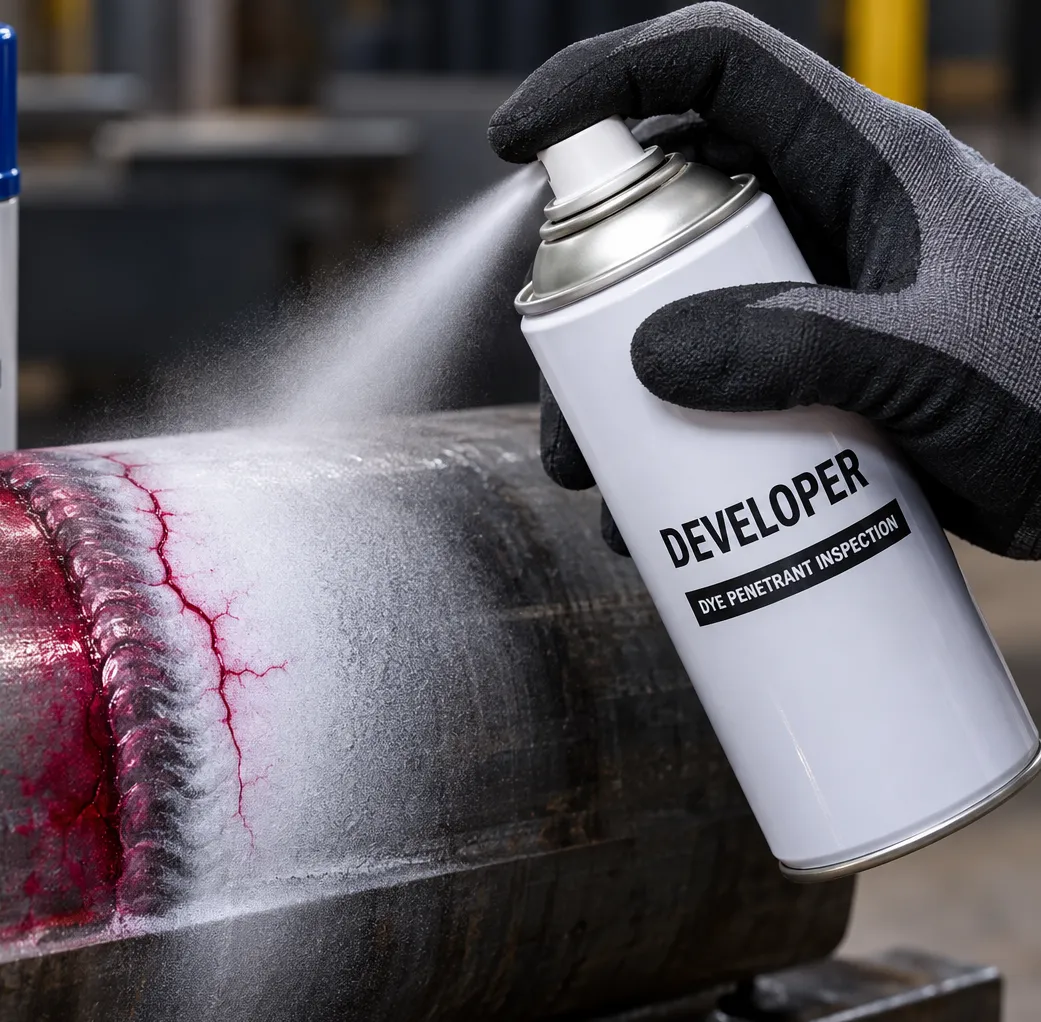
Developer is then applied.
Its purpose is to help draw penetrant trapped within surface-breaking discontinuities back toward the surface, creating a more visible indication.
This can assist inspectors when examining suitable non-porous materials for relevant surface defects.
Surface Preparation Comes First
Developer spray cannot compensate for poor preparation.
Oil, grease, scale, dirt, paint or other contamination can interfere with penetrant testing. The surface therefore needs to be prepared according to the inspection procedure and product instructions.
A common mistake is treating penetrant inspection as simply spraying three products in quick succession. Correct testing requires attention to cleaning, application, timing, excess penetrant removal, developer use and interpretation.
Application Quality Matters
More developer is not automatically better.
An excessively heavy layer may reduce the clarity of indications. Poor coverage can also make interpretation difficult.
The appropriate application method depends on the specific product and inspection procedure, so users should follow the manufacturer's technical instructions.
The developer should generally create suitable coverage without unnecessarily flooding the inspection surface.
Where Can Penetrant Testing Be Useful?
Depending on material suitability, procedure requirements and applicable standards, penetrant testing can be used when checking fabricated parts such as:
- Welded components
- Machined parts
- Metal joints
- Maintenance components
- Fabricated assemblies
- Selected castings
- Non-porous metal surfaces
It is important to understand the limitation of the method. Dye penetrant testing is intended for discontinuities that are open to the surface. It does not provide a complete picture of internal material conditions.
Inspection Results Need Proper Interpretation
Seeing a visible indication does not automatically establish the severity of a defect.
Relevant indications need to be interpreted according to the applicable inspection criteria, code, specification or quality procedure. Qualified inspection personnel may be required where formal acceptance decisions are involved.
This distinction is particularly important for industrial manufacturers completing critical fabrication work.
Store Inspection Consumables Correctly
Testing products should be kept according to manufacturer recommendations. Containers should be protected from inappropriate heat and other unsuitable storage conditions.
Teams should also check product condition, identification and relevant expiry information where applicable before use.
For engineering workshops and fabrication businesses across Mumbai, Maharashtra, organized storage makes it easier to maintain consistent inspection practices.
Developer Is One Part of the Process
Reliable penetrant testing depends on the complete procedure rather than one aerosol can.
Flaw Test Developer Spray works together with appropriate surface preparation, penetrant application, excess penetrant removal, correct development time and proper interpretation.
Industrial teams that understand the purpose of each stage are better positioned to use penetrant inspection effectively instead of treating it as a simple visual spray test.
Keywords